TRANSPARENCY
LEGAL DOCUMENTATION
Statutes of Episteme. Social Research and Intervention.
The Statutes approved by the Board of Directors of Episteme. Social Research and Intervention establish that:
Episteme. Social Research and Intervention is constituted as an organisation in accordance with Organic Law 1/2022 of 22 March and the corresponding supplementary regulations, with legal personality and full legal capacity, on a non-profit basis and for an indefinite period.
To fulfil the stated purposes, Episteme. Social Research and Intervention shall carry out activities directed towards achieving them.
The organisation’s representative body is the Board of Directors, and its highest decision-making body is the General Assembly.
Any matters not covered by the Statutes shall be governed by Organic Law 1/2002 of 22 March, regulating the right of association, and by the applicable supplementary provisions.
Current version, incorporating the consolidated text of the Statutes and the amendments approved by the General Assembly and registered with the National Register of Associations. The most recent amendment was approved by the Extraordinary General Assembly of 11 December 2025.
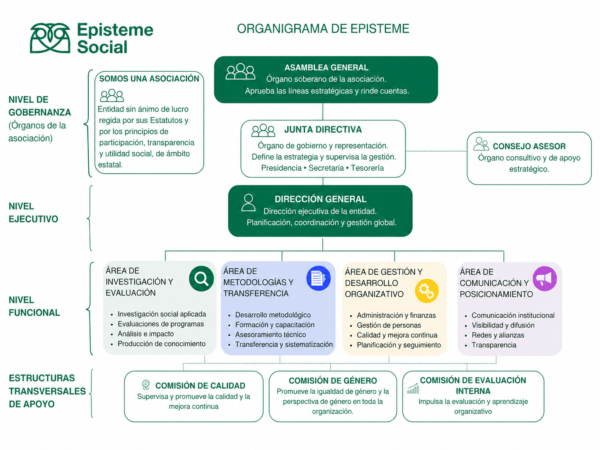
Organisational chart of Episteme. Social Research and Intervention.
Board of Directors of Episteme. Social Research and Intervention.
The Board of Directors is composed of David Pere Martínez Oró, Chair of the Board since 28 May 2015; Antoniu Llort Suárez, Secretary since 28 May 2015; and Òscar Parés Franquero, Treasurer. It is the organisation’s representative body.
As a general rule, the powers of the Board of Directors extend to all acts relating to the purposes of the Association, provided that these Statutes do not require the express authorisation of the General Assembly. The specific powers of the Board of Directors are:
To direct the Association’s activities and manage its economic and administrative affairs, including entering into the appropriate contracts and legal acts.
To implement the resolutions of the General Assembly.
To prepare and submit the balance sheets and annual accounts to the General Assembly for approval.
To decide on the admission of new members.
To appoint delegates for specific activities of the Association.
Any other power that is not reserved exclusively to the General Assembly of members.
Meeting frequency: monthly.
Secretariat
The Secretary is responsible for directing the Association’s strictly administrative work, issuing certificates, maintaining the legally required books of the Association and keeping the membership register.
The Secretary safeguards the organisation’s documentation and ensures that notifications concerning the appointment of Boards of Directors and other registrable corporate resolutions are submitted to the relevant registers, as well as ensuring compliance with documentary obligations under the applicable legal requirements.
The Secretary replaces the Chair in the event of absence due to illness or any other reason and assumes the same powers.
Management
Implements the organisation’s operational plans in order to achieve the objectives established by the Board of Directors.
Manages and optimises the available human resources, including both paid staff and volunteers.
Prepares and implements the annual budget management plan and directs and oversees fundraising activities.
Coordinates the different areas, supervises the proper implementation of policies and, together with the team, defines methodological instruments to improve the organisation’s management.
Maintains institutional and policy relations in order to reach cooperation agreements.
Promotes marketing and awareness-raising campaigns, as well as strategies to extend the organisation’s reach.
Designs mechanisms for evaluating the organisation’s activities and, on the basis of the results, redefines the action plan.
Treasury
The Treasurer collects and safeguards the Association’s funds and carries out payment orders issued by the Treasurer or by persons authorised by the Board of Directors.
Advisory Board
Advises the Board of Directors or Management according to identified needs. It is a consultative body composed of professionals with extensive experience.
Frequency: according to need, at least once a year.
Gender Committee
To monitor and evaluate the Equality Plan.
To prepare reports and/or proposals to make the principle of equal opportunities effective.
Where appropriate, to propose amendments to the Plan in order to adapt it to new circumstances affecting the organisation.
To collect and channel staff initiatives and suggestions concerning equality between women and men.
Minimum frequency: quarterly, or on request according to need.
Internal Evaluation Committee
To ensure the proper implementation of the PAE.
To adapt the PAE on an ad hoc basis in order to obtain a self-evaluation design specific to each programme.
To design the questionnaires required to meet the objectives of the PAE.
To draft the ‘Participant Observation Guide for the Self-Evaluation of Episteme Programmes’.
To analyse the design of potential new programmes in order to develop their self-evaluation design.
To analyse data obtained through the evaluation methods.
To draft the self-evaluation reports for each programme.
To draft and submit the annual self-evaluation report.
To present the self-evaluation results to Management and the Board of Directors whenever considered appropriate, and at least once a year, and to propose improvement measures to Management.
To monitor the introduction of improvements by Management in order to increase quality, effectiveness and efficiency, and to improve the self-evaluation processes.
Meeting frequency: weekly.
Quality Committee
To prepare Episteme’s quality manual.
To design and define Episteme’s operational processes.
To monitor Episteme’s quality processes.
To manage and coordinate all matters relating to Episteme’s quality and excellence.
To monitor and evaluate the objectives of each programme.
To make improvement proposals and monitor their implementation.
To propose and amend the objectives of each programme.
Resolution registering Episteme with the National Register.
The procedure for registering Episteme with the National Register was conducted in accordance with Law 30/1992 of 26 November on the legal regime of public administrations and common administrative procedure, and with the specific regulations governing the right of association.
The resolution dated 23 September 2015 states that Episteme is registered with the National Register of Associations: Group 1 / Section 1 / National number 608377.
Legal framework
Basic national legislation
Spanish Constitution —Article 22— of 27 December 1978 (Official State Gazette No. 311.1 of 29 December).
Universal Declaration of Human Rights, adopted and proclaimed by the 183rd United Nations General Assembly on 10 December 1948 —Articles 20 and 21—.
European Convention for the Protection of Human Rights and Fundamental Freedoms, signed in Rome on 4 November 1950 —Article 11—. Instrument of ratification of 26 September 1979 (Official State Gazette No. 243 of 10 October 1979).
International Covenant on Civil and Political Rights of 19 December 1966 —Article 22—. Instrument of ratification of 13 April 1977 (Official State Gazette No. 103 of 30 April 1977).
European Community Resolution of 13 March 1987 on non-profit associations (Official Journal of the European Communities No. C 99/205 of 13 April 1987).
European Outline Convention on Transfrontier Co-operation between Territorial Communities or Authorities, signed in Madrid on 21 May 1980. Instrument of ratification of 10 July 1990 (Official State Gazette No. 248 of 16 October 1990; correction of errors in Official State Gazette No. 260 of 30 October 1990).
Organic Law 1/2002 of 22 March regulating the right of association (Official State Gazette No. 73 of 26 March).
Organic Law 10/1995 of 23 November on the Criminal Code —Articles 510 to 521— (Official State Gazette No. 281 of 24 November).
Royal Decree 949/2015 of 23 October approving the Regulations of the National Register of Associations (Official State Gazette No. 255 of 24 October).
Royal Decree 1740/2003 of 19 December on procedures relating to public-benefit associations (Official State Gazette No. 11 of 13 January 2004).
Law 38/2003 of 17 November, General Subsidies Law.
Royal Decree 397/1988 of 22 April regulating the registration of youth associations (Official State Gazette No. 102 of 28 April).
Royal Decree of 24 July 1889 publishing the Civil Code —Articles 28, 35 to 39 and 41— (Official State Gazette No. 206 of 25 July).
Order INT/1089/2014 of 11 June approving the activity-report template to be used in procedures relating to public-benefit associations (Official State Gazette No. 156 of 27 June).
Catalonia
Organic Law 6/2006 of 19 July reforming the Statute of Autonomy of Catalonia —Article 118— (Official State Gazette No. 172 of 20 July).
Law 4/2008 of 24 April on Book Three of the Civil Code of Catalonia, concerning legal persons (Official State Gazette No. 131 of 30 May).
Royal Decree 3526/1981 of 29 December on the transfer of services (Official State Gazette No. 47 of 24 February 1982).
Royal Decree 1266/2007 of 24 September on the transfer of functions from the State Administration to the Government of Catalonia concerning recognition of the public-benefit status of associations and the application of tax benefits to associations and foundations (Official State Gazette No. 230 of 25 September).
QUALITY
QUALITY CERTIFICATE: EXCELLENCE IN MANAGEMENT AND SOCIAL COMMITMENT
Episteme Social holds the Quality Certificate for Excellence in Management and Social Commitment. The Episteme Social team has demonstrated personal and selfless dedication to advancing and evidencing that our organisation meets the standards expected of a committed organisation and operates a quality management system actively focused on continuous improvement.
The Recognition for Management and Social Commitment awarded by the Fundación Grupo Develop was assessed by José Luis Antolín. The certificate issued by Bureau Veritas confirms compliance with standards intended to distinguish our organisation from other entities which, despite holding some form of certification, are not recognised as ‘socially committed’.
DECLARATION OF COMMITMENT TO QUALITY IN THE THIRD SECTOR OF SOCIAL ACTION
EPISTEME SOCIAL RESEARCH AND INTERVENTION, registered with the National Register of Associations under national number 608,377 and headquartered at 146 Carrer de Floridablanca, Barcelona, has endorsed the Declaration of Commitment to Quality in the Third Sector of Social Action, a project promoted by the Platform of Social Action NGOs. Through this endorsement, it undertakes to incorporate the values, principles and criteria set out in the declaration into its management systems. The organisation endorsed the declaration on 16 October 2023.
Certificate of training as an Internal Auditor of ISO 9001:2008 Quality Management Systems, issued by Det Norske Veritas (DNV)
This certificate attests to specific training in the internal auditing of quality management systems and provides evidence of the technical competence required to conduct internal audits.
Minutes of the Board of Directors’ commitment to quality, evaluation and self-evaluation at Episteme.
At the Extraordinary General Assembly held on 24 May 2022, the Board of Directors resolved to update the quality, evaluation and self-evaluation systems of Episteme. Social Research and Intervention.
Good Practice Certificate from the Ibero-American Network of NGOs Working in Drugs and Addictions (RIOD).
Episteme. Social Research and Intervention participated in the ninth edition of the RIOD initiative to identify good-practice projects in 2022. Within the framework of an International Evaluation Committee composed of recognised organisations and experts, the submitted initiative was assessed: ‘Community Service: a multicomponent pilot programme —community, safety and nightlife— for the environmental prevention, with a gender perspective, of harms associated with alcohol and other drugs in nightlife settings’. Recommendations were made to improve the initiative. In the evaluation report, the Community Service programme obtained a score of 64 out of 70.
Code of conduct for staff of Episteme. Social Research and Intervention.
This section describes a set of behaviours and practices that must govern the day-to-day work of Episteme. Social Research and Intervention, both within the organisation itself and in its relations with the different people, groups and entities with which it interacts. It establishes a code of conduct and a code of ethics.
Code of ethics. Ethical values and principles of Episteme. Social Research and Intervention.
The Code of Ethics of Episteme. Social Research and Intervention sets out the values and principles guiding the actions of the organisation and everyone who forms part of it. Its purpose is to promote a culture based on integrity, transparency, respect, regulatory compliance and social responsibility through twelve corporate ethical principles that guide our daily work.
Occupational risk prevention
This document certifies that Episteme. Social Research and Intervention maintains a contractual relationship, through an agreement for preventive activities, in accordance with Article 20 of Royal Decree 39/1997 approving the Regulations on Prevention Services.
It also states that the organisation is up to date with payments for the contracted services through 8 August 2022.
This is without prejudice to services and/or activities invoiced according to use, or to any subsequent checks that may be carried out.
Internal notice. Working-time records.
Episteme. Social Research and Intervention uses a working-time record system to monitor the working hours of its professionals.
Training in the quality and compliance system in the field of data protection.
Diploma certifying that Sara Sáez Sánchez, the organisation’s Head of Management and Administration, has received data-protection training covering the following modules: processing of personal data, electronic communications, occupational risk prevention regulations, working-time records and criminal liability.
Advice and adaptation. Law 34/2002 on information-society services and electronic commerce.
Episteme. Social Research and Intervention must comply with Article 22.2 of Law 34/2002 of 11 July on information-society services and electronic commerce (LSSI-CE), as well as the recommendations published by the Spanish Data Protection Agency in its Guide on the Use of Cookies.
Other quality certificates
As part of its commitment to quality and continuous training in this area, Episteme. Social Research and Intervention has completed various courses in order to remain up to date.
‘ARC Programme: Advancing the Quality Challenges of NGOs’. Compliance (71 hours).
See more
Course on ‘Managing Gender Equality in the Business Environment’ (60 hours). Professional Group Conversia SLU.
‘Gestiona-T’ Programme. Workshop 1. ‘How to Obtain a Quality Certificate in a Social Organisation’ (6 hours).
See more
‘Gestiona-T’ Programme. Workshop 2. ‘Tools for Implementing a Quality Plan’ (6 hours).
See more
‘Gestiona-T’ Programme. Workshop 3. ‘Process Management in a Social Organisation’ (6 hours).
See more
‘Gestiona-T’ Programme. Workshop 4. ‘Project Formulation, Management, Reporting and Evaluation’ (6 hours).
See more
Good Practice Certificate
See more
COMPLIANCE. DATA PROTECTION AND QUALITY
Data-protection audit report
On 7 March 2022, Episteme. Social Research and Intervention underwent a quality audit concerning data protection.
Measures and procedures for quality-system and compliance operations under the GDPR.
Professional Group Conversia SLU prepared a document setting out all measures applicable to the quality-system and compliance operations of Episteme. Social Research and Intervention.
Impact assessment.
Professional Group Conversia SLU concluded that, after completing the three levels of analysis for each processing activity carried out by Episteme. Social Research and Intervention, none of the processing operations posed a high risk to the rights and freedoms of data subjects with regard to personal-data protection.
Video surveillance.
Episteme. Social Research and Intervention reports that the video-surveillance cameras installed on its premises form part of a closed-circuit system. Images are viewed but are not stored on any physical medium under any circumstances.
Code of ethics and conduct mailbox: etica@epistemesocial.org
EQUALITY POLICIES
First Equality Plan of Episteme. Social Research and Intervention.
The First Equality Plan provides, on the one hand, an opportunity to assess, from a gender perspective, the current situation of everyone working at Episteme. Social Research and Intervention. On the other hand, it systematises good practices incorporated since the organisation’s inception, makes its position on gender equality visible, identifies areas requiring greater emphasis and adapts the Equality Plan specifically to an association with our characteristics. It is therefore a roadmap based on a participatory assessment of internal needs, with a firm commitment to identifying any bias arising from gender inequality, making actions clearly visible and progressively improving all aspects related to gender equality.
Guide to Applying a Gender Perspective throughout the Programme Cycle of Episteme. Social Research and Intervention.
The incorporation of a gender perspective into our programmes starts from the recognition that differences between genders have been inherited from social, cultural, economic and historical contexts that shape people’s bodies and identities.
Applying a gender perspective makes it possible to conduct research and social interventions that reflect the heterogeneous reality of the people involved and take account of their symbolic universe and needs.
Protocol on sexual harassment and harassment on grounds of gender.
Sexual harassment and harassment on grounds of gender in the workplace must be understood as another form of discrimination, since they contribute to maintaining inequality at work.
Beyond the obligation imposed by Organic Law 3/2007 for companies to adopt specific measures to prevent sexual harassment and harassment on grounds of gender in the workplace, Episteme. Social Research and Intervention, as an organisation working in the social field, considers it especially important to define an explicit policy against such conduct. This protocol sets out that policy as a key instrument for preventing, addressing and managing any situation that may arise within our organisation.
Gender Committee: permanent Equality Representative at Episteme.
igualtat@epistemesocial.org
ANNUAL REPORTS
2025 ANNUAL REPORT
2024 ANNUAL REPORT
2023 ANNUAL REPORT
2022 ANNUAL REPORT
2021 ANNUAL REPORT
ANNUAL PLANS
2023 Strategic Plan
Self-Evaluation Plan
Episteme Continuing Training Plan (PFCE)
Strategic Communication Plan
ANNUAL DOCUMENTATION
2025 DOCUMENTATION
International cooperation contract
FIIAPP – COPOLAD III (Latin America, the Caribbean and Europe)
CM-APAS-2025-116
Implemented in 2025
International technical assistance for the development of evidence-based tools and guidance in the field of addictions.
Person-centred, evidence-based treatment guide for fentanyl and methamphetamine use disorders in Mexico.
Technical-assistance project to develop a clinical guide for healthcare professionals, aimed at strengthening the treatment of fentanyl and methamphetamine use disorders through a person-centred approach based on scientific evidence and adapted to the context of the Mexican health system.
Minor contract
Ministry of Health of the Government of the Balearic Islands (General Secretariat).
CM N06 2025/19503
Implemented in 2025
Minor service contract for training and technical advice in prevention.
Provision of technical assistance to train and build the capacity of professionals in recording data from addiction-prevention programmes, covering needs assessment, design, processes, resources, outcomes and impact. The project included implementation and technical support in the use of the Tékne system for programme registration, monitoring and evaluation, strengthening information quality and evidence-based decision-making.
Contract
Barcelona Provincial Council. Department of Social Sustainability, Life Cycle and Community. Dependency and Social Vulnerability Support Service
2022/2137
Award decision for technical-support contracts to develop strategic addiction projects for local authorities in the province of Barcelona.
Support for developing plans for the prevention of drug use and problematic screen use – Vall del Tenes Association of Municipalities. Code 24/Y/357450
Support for developing plans for the prevention of drug use and problematic screen use – Sant Feliu de Llobregat City Council. XGL code 24/Y/357443
Minor contract
Department of Health of the Government of Catalonia (Directorate-General for Addictions, HIV, Sexually Transmitted Infections and Viral Hepatitis).
SA-2025-548
Minor service contract for the development of addiction-prevention materials for pre-adolescents and their families.
‘Pere’s Journey’
Development of an illustrated story for pre-adolescents to promote the identification of risks, protective factors and healthy decision-making, accompanied by a guide for families with practical guidance on addiction prevention and fostering protective family environments.
Grant
Department of Health of the Government of Catalonia (Directorate-General for Addictions, HIV, STIs and Viral Hepatitis).
SLT039/24/000063
Implemented in 2025
Competitive grant for prevention, comprehensive care, harm reduction and training activities in the field of drug dependence and behavioural addictions.
Programme:
‘Quality in addiction-prevention programmes’.
Grant
Government Delegation for the National Plan on Drugs (Ministry of Health)
2025G063
Implemented during 2025–2026
2025 national call for grants to private non-profit organisations operating nationwide to carry out supra-regional addiction programmes.
Programmes:
Tékne. Evaluation system for addiction-prevention programmes.
Study of the NPS (new psychoactive substances) market and its impact on young people in Spain.
Nitrous oxide: an analysis of ‘laughing gas’ use in Spain.
Grant
Ministry of Social Rights, Consumer Affairs and the 2030 Agenda
402/2025
Being implemented in 2026
2025 national call for grants to carry out activities of general interest considered to be of social interest, funded through the 0.7% personal-income-tax and corporation-tax allocations.
Programmes:
HERACLES. Social rights among hidden drug-dependent populations.
HIPÓCRATES. Medicalisation and quality of life among older people. A study of overmedicalisation in later life.
TEMIS. Outcome and effectiveness evaluation of addiction-prevention programmes.
2024 DOCUMENTATION
Grant
Ministry of Social Rights, Consumer Affairs and the 2030 Agenda
221/2024
Implemented in 2025
2024 national call for grants to carry out activities of general interest considered to be of social interest, funded through the 0.7% personal-income-tax and corporation-tax allocations.
Programmes:
AFRODITA. Pleasure, pornography consumption, construction of realities and gender-based violence. Research aimed at generating knowledge about sexual behavioural addictions, especially online pornography.
EPIONE. Research aimed at understanding instrumental substance use among hidden working populations. A contribution of good practices for prevention.
ATENEA. External evaluations of active addiction-prevention programmes.
Grant
Government Delegation for the National Plan on Drugs (Ministry of Health)
2024G058
Implemented in 2025
2024 national call for grants to private non-profit organisations operating nationwide to carry out supra-regional addiction programmes.
Programmes:
From fentanyls to nitazenes. Study of the threat posed by nitazenes in Spain.
Methamphetamine in Spain: trends, profiles and harms.
Grant
Department of Health of the Government of Catalonia (Directorate-General for Addictions, HIV, STIs and Viral Hepatitis).
SLT031/23/000043
Implemented in 2024
Competitive grant for prevention, comprehensive care, harm reduction and training activities in the field of drug dependence and behavioural addictions.
Programme:
‘Quality in addiction-prevention programmes’.
Minor contract
Government of Valencia – Directorate-General for Public Health
29/2024/2281
Implemented in 2024
Design, delivery and evaluation of specialised training on evidence, quality and evaluation in addiction prevention, using the Tékne 3.0 system as a methodological support tool.
Programme:
‘Training in evidence, quality and evaluation in addiction prevention with the support of the Tékne 3.0 system’.
Minor contract
Government of Aragon – Directorate-General for Public Health
SAN_DGSP_2024_MN12
Implemented in 2024
Provision of training and evaluation services aimed at strengthening the quality and evaluation of addiction-prevention programmes developed by the Specialised Addiction Programmes (PEA).
Programme:
‘Training and evaluation of addiction-prevention programmes developed by the Specialised Addiction Programmes (PEA)’.
Contract
Barcelona Provincial Council. Department of Social Sustainability, Life Cycle and Community. Dependency and Social Vulnerability Support Service
2022/2137
Implemented during 2023–2024
Contract based on the framework agreement for the provision of technical-support services to local authorities in the province of Barcelona in the field of addictions.
Support for developing plans for the prevention of drug use and problematic screen use – Terrassa City Council. Code 23/Y/338586
Support for developing plans for the prevention of drug use and problematic screen use (189 hours) – Canovelles City Council. Code 23/Y/338587
2023 DOCUMENTATION
International cooperation contract
FIIAPP – CADAP 7 (Central Asia)
APAS-2022-017
Implemented between 2023 and 2024
Technical assistance to strengthen drug policies in Central Asia
Contract awarded by the International and Ibero-American Foundation for Administration and Public Policies (FIIAPP) to provide technical assistance under the CADAP 7 programme. The project includes the design and development of training activities, the facilitation of drug-policy dialogue processes and the strengthening of institutional capacities to promote evidence-based public policies and the exchange of experience among Central Asian countries.
International cooperation contract
FIIAPP – COPOLAD III (Latin America, the Caribbean and Europe)
APAS-2022-033
Implemented between 2023 and 2024
Technical assistance to strengthen public drug policies
Contract awarded by the International and Ibero-American Foundation for Administration and Public Policies (FIIAPP) to provide technical assistance under the COPOLAD III programme, aimed at strengthening drug policies in Latin America, the Caribbean and the European Union. The project supports public administrations in promoting dialogue and coherence in public drug policies, as well as strengthening care and social and economic inclusion programmes for people experiencing drug-use problems, incorporating human-rights, gender-equality and sustainable-development approaches.
Grant
Ministry of Social Rights, Consumer Affairs and the 2030 Agenda
258/2023
Implemented in 2024
2023 national call for grants to carry out activities of general interest considered to be of social interest, funded through the 0.7% personal-income-tax and corporation-tax allocations.
Programmes:
HIGIEA. Multilevel analysis of the quality, needs, design, target populations, objectives, settings, implementation, evaluation and effectiveness of programmes,
projects and local addiction-prevention plans.
ÍCARO. Medicalised youth, fragmented lives and uncertain futures. Research aimed at generating knowledge on health and social care and analysing good practices in
health and social care resources.
VESTA. Online training and capacity-building for addiction professionals in addressing violence against women in care services, with the aim of enabling them to develop a gender-sensitive care protocol.
Grant
Government Delegation for the National Plan on Drugs (Ministry of Health)
2023G069
Implemented in 2024
2023 national call for grants to private non-profit organisations operating nationwide to carry out supra-regional addiction programmes.
Programmes:
Fentanyl in Spain: evidence, perceptions and realities.
Community Service: evaluation methodology and final results.
Grant
Department of Health of the Government of Catalonia (Directorate-General for Addictions, HIV, STIs and Viral Hepatitis).
SLT030/22/000033
Implemented in 2023
Competitive grant for prevention, comprehensive care, harm reduction and training activities in the field of drug dependence and behavioural addictions.
Programme:
‘Quality in addiction-prevention programmes’.
Contract
Barcelona Provincial Council. Department of Social Sustainability, Life Cycle and Community. Dependency and Social Vulnerability Support Service
2022/2137
Award decision for technical-support contracts to develop strategic projects in the field of addictions for local authorities in the province of Barcelona.
Support for developing plans for the prevention of drug use and problematic screen use – Mataró City Council. XGL Code 22/Y/319009
Support for developing plans for the prevention of drug use and problematic screen use – Rubí City Council. XGL Code 22/Y/319010
Support for developing plans for the prevention of drug use and problematic screen use – Arenys de Mar City Council. XGL Code 22/Y/319006
Minor contract
Barcelona Provincial Council
2023/0001938
Award decision for the delivery of training activities for staff of local authorities in the province of Barcelona, within the Barcelona Provincial Council’s training programme.
‘Evaluation of addiction-prevention plans and programmes: from theory to practice using a straightforward methodology’
Accreditation
Government of Catalonia. Department of Labour, Social Affairs and Families.
Resolution accrediting Episteme. Social Research and Intervention as a provider within the Public Social Services Network to deliver the Specialised Intervention Service (SIE) for gender-based violence. The accreditation recognises compliance with the quality and solvency requirements established by Catalan regulations for providing this service.
SIE Raval
Minor contract
Barcelona Provincial Council
2022/14577
Minor service contract for technical support and methodological advice to 19 local authorities in the province of Barcelona regarding the review of practices and the implementation of local plans for the prevention of drug use and problematic screen use.
Continuous-improvement forums for local plans on the prevention of drug use and problematic screen use. Technical assistance aimed at strengthening the quality of local plans through the exchange of good practices, methodological innovation, evaluation and the development of guidance to improve municipal prevention strategies.
2022 DOCUMENTATION
Grant. Ministry of Social Rights and the 2030 Agenda. Other purposes of social interest.
Programmes:
Empowerment processes and access to rights among (semi-)hidden populations with drug dependence. Research aimed at evaluating the effectiveness of health and social care resources and the impact of public policies.
Grant. Ministry of Social Rights and the 2030 Agenda. Other purposes of social interest.
Programmes:
DIKÉ. Social determinants of health and lifestyle among hidden populations experiencing addiction problems. Research aimed at generating knowledge on health and social care and analysing good practices.
Grant. The Government Delegation for the National Plan on Drugs calls for competitive grants to private non-profit organisations operating nationwide to develop addiction-prevention and treatment projects funded through the European Recovery and Resilience Facility.
Programmes:
Tékne 3.0. Quality-management system for prevention plans, programmes, projects and actions. Needs, planning and advanced evaluation.
Calíope. Consolidation of online, asynchronous postgraduate training in behavioural addictions: from loot boxes to cryptocurrencies.
Digitalisation and virtualisation of the Community Service evaluation and intervention processes.
Grant. The Government Delegation for the National Plan on Drugs annually calls for grants to private non-profit organisations operating nationwide, charged to the relevant allocations in the General State Budget and the Fund of Assets Seized from Drug Trafficking and Other Related Offences. Call resolution.
Programmes:
Community Service. Multicomponent pilot programme —community, safety and nightlife— for the environmental prevention, with a gender perspective, of harms associated with alcohol and other drugs in nightlife settings. 2021G066
Technical support in evaluation for drug-dependence organisations to improve the quality of prevention programmes. 2021G066
The psychosocial and motivational dimensions of sports betting and gambling in the post-pandemic context. 2021G066
Grant. The Government Delegation for the National Plan on Drugs annually calls for grants to private non-profit organisations operating nationwide, charged to the relevant allocations in the General State Budget and the Fund of Assets Seized from Drug Trafficking and Other Related Offences. Call resolution.
Programmes:
Grant: Community Service. Multicomponent environmental-prevention pilot programme. Effectiveness-evaluation phase. 2022G023
Grant: technical support in evaluation for addiction organisations to improve the quality of prevention programmes. 2022G023
Grant. The Government Delegation for the National Plan on Drugs calls for competitive grants to private non-profit organisations operating nationwide to develop addiction-prevention and treatment projects funded through the European Recovery and Resilience Facility.
Programmes:
Tékne. Quality-management system for prevention plans, programmes, projects and actions. Needs, planning, evaluation and improvement.
Calíope. Online, asynchronous postgraduate training in behavioural addictions: from loot boxes to cryptocurrencies.
Digitalisation and virtualisation of the Community Service evaluation and intervention processes.
Grant. Government of Catalonia. Department of Equality and Feminisms. TSF089/21/001217
Programmes:
Demanding respect. Proactive responses to racism.
Grant. Government of Catalonia. Department of Health (Drug Dependence).
Programmes:
Harm-reduction programme associated with cannabis clubs and user associations.
Drug use and young people at high social risk: from prevention to harm reduction.
Metzineres. Harm reduction, support and follow-up for women who do not access social services.
Minor contract. Government of Aragon. Department of Health. Directorate-General for Public Health. File DGSP/11/2022.
Programme:
Environmental-prevention project related to nightlife in Aragon.
Minor contract. Government of Aragon. Department of Health. Directorate-General for Public Health.
Programme:
Prevention of gambling-related harms. A new public-health challenge.
Minor contract. Barcelona Provincial Council. Dependency and Social Vulnerability Support Service
Programme:
Continuous-improvement forums for local plans on the prevention of drug use and problematic screen use. 2021/0009315.
Minor contract. Barcelona Provincial Council. Dependency and Social Vulnerability Support Service
Programme:
Practical guide to evaluating local addiction-prevention plans in the Drug Prevention Plan of the Vall del Tenes Intermunicipal Association.
Minor contract. Barcelona Provincial Council. Dependency and Social Vulnerability Support Service
Programme:
Local plans. Strategic projects in the field of addictions. 2022/0002137.
Minor contract. FIIAPP.
Programme:
CADAP 7 – Technical assistance for designing and preparing training sessions and technically implementing national and regional drug-policy dialogue meetings in Central Asia. APAS-2022-017.
Contract. Barcelona Provincial Council
2022/16896
Implemented in 2022
Technical-assistance contract to strengthen the evaluation of local addiction-prevention policies.
Procurement resolution for implementing the Practical Guide to Evaluating Local Addiction-Prevention Plans in the Vall del Tenes Intermunicipal Association, with the aim of strengthening evidence-based evaluation of prevention policies.
Programme:
‘Practical Guide to Evaluating Local Addiction-Prevention Plans’.
2021 DOCUMENTATION
Grant. Ministry of Social Rights and the 2030 Agenda. Grants to organisations carrying out activities of general interest considered to be of social interest, charged to the personal-income-tax and corporation-tax allocations for 2021. Ministry–Episteme agreement.
Programme:
Empowerment processes and access to rights among (semi-)hidden populations with drug dependence. Research aimed at evaluating the effectiveness of health and social care resources and the impact of public policies.
Grant. The Government Delegation for the National Plan on Drugs annually calls for grants to private non-profit organisations operating nationwide, charged to the relevant allocations in the General State Budget and the Fund of Assets Seized from Drug Trafficking and Other Related Offences. Call resolution.
Programmes:
Community Service. Multicomponent pilot programme —community, safety and nightlife— for the environmental prevention, with a gender perspective, of harms associated with alcohol and other drugs in nightlife settings. Technical support in evaluation for drug-dependence organisations to improve the quality of prevention programmes.
The psychosocial and motivational dimensions of sports betting and gambling in the post-pandemic context.
Grant. Government of Catalonia. Department of Health. Grants to fund private non-profit organisations for prevention, comprehensive care, harm reduction and training activities in the field of drug dependence and behavioural addictions during 2021, submitted under the call published through Resolution SLT/622/2021.
Programmes:
Risk-reduction programme for cannabis clubs and user associations.
Drug use and young people at high social risk: from prevention to harm reduction.
Support for substance use from a harm-reduction perspective.
Minor contract. Barcelona Provincial Council. Department of Social Cohesion, Citizenship and Welfare. File 2021/0018270
Programme:
Continuous-improvement forum for local drug-prevention plans.
Minor contract. Barcelona Provincial Council. Department of Social Cohesion, Citizenship and Welfare. File 2021/0006183
Programme:
System for optimising the planning and evaluation of drug-dependence programmes.
2020 DOCUMENTATION
Grant. The Government Delegation for the National Plan on Drugs annually calls for grants to private non-profit organisations operating nationwide, charged to the relevant allocations in the General State Budget. Call resolution.
Programmes:
Technical support in evaluation for drug-dependence organisations to improve the quality of prevention programmes.
Implementation of the Community Service pilot programme for preventing harms associated with alcohol and other drugs.
Grant. The Government Delegation for the National Plan on Drugs annually calls for grants to private non-profit organisations operating nationwide, charged to the Fund of Seized Assets. Call resolution.
Programmes:
Online gambling in the post-pandemic context. The transition from sports betting to gambling games.
Implementation of the Community Service pilot programme for preventing alcohol-related harms.
Minor contract. Barcelona Provincial Council. Department of Social Cohesion, Citizenship and Welfare. File 2020/0014181
Programme:
Continuous-improvement forum for local drug-prevention plans.
Minor contract. Government of Catalonia. Department of Health.
Programme
Development of risk-reduction content for cannabis clubs and user associations.
2019 DOCUMENTATION
Grant. The Government Delegation for the National Plan on Drugs annually calls for grants to private non-profit organisations operating nationwide, charged to the relevant allocations in the General State Budget. Call resolution.
Programme:
Design of the evaluation system for the ‘Responsible Service’ programme.
Grant. The Government Delegation for the National Plan on Drugs annually calls for grants to private non-profit organisations operating nationwide, charged to the Fund of Seized Assets. Call resolution.
Programmes:
Online betting. Knowledge and indicated prevention.
Evaluation of the Responsible Service programme. Diagnostic phase.
Minor contract. Barcelona Provincial Council
Programme:
Continuous-improvement forum for local drug-prevention plans. File 2019/0005915
2018 DOCUMENTATION
Grant. The Government Delegation for the National Plan on Drugs annually calls for grants to private non-profit organisations operating nationwide, charged to the Fund of Seized Assets. Call resolution.
Programme:
Online betting. Young people, contexts, risks and addiction.
2017 DOCUMENTATION
Grant. The Government Delegation for the National Plan on Drugs annually calls for grants to private non-profit organisations operating nationwide, charged to the Fund of Seized Assets. Call resolution.
Programme:
Opioids in Spain: a new epidemic?
2016 DOCUMENTATION
Grant. The Government Delegation for the National Plan on Drugs annually calls for grants to private non-profit organisations operating nationwide, charged to the Fund of Seized Assets. Call resolution.
Programme.
Nature and extent of cannabis use in Spain. Between normalisation and epidemic.