
Advances and Challenges in Addiction Prevention: A Perspective from the HIGIEA Project
Advances and Challenges in Addiction Prevention: A Perspective from the HIGIEA Project
By: Aida Longan Zarzoso
Why, despite numerous efforts, do prevention programmes still fail to demonstrate their effectiveness? Addiction prevention in Spain is undergoing a period of transformation. Although international standards such as the Universal Prevention Curriculum (UPC) and guidelines from organisations like UNODC, WHO, and EMCDDA are in place, current programmes continue to face significant challenges: a lack of scientific evidence, unequal integration of gender perspectives, and limited evaluation of outcomes. The HIGIEA project, spearheaded by Episteme Social, seeks to bridge these gaps and enhance the quality of addiction prevention through a mixed-method and multi-level approach.
At HIGIEA, we conducted both qualitative and quantitative analyses, combining interviews with 27 professionals in the field and a questionnaire that garnered 278 responses. The results reveal structural weaknesses, territorial disparities, and a disconnect between actual needs and implemented actions.
Evaluation: A Key Yet Underutilised Tool
One of the most significant findings is the necessity to integrate evaluation at every stage of prevention programmes. From design to implementation, measuring outcomes not only ensures quality but also enables real-time strategy adjustments. However, the lack of resources, training, and time limits the application of rigorous evaluations.
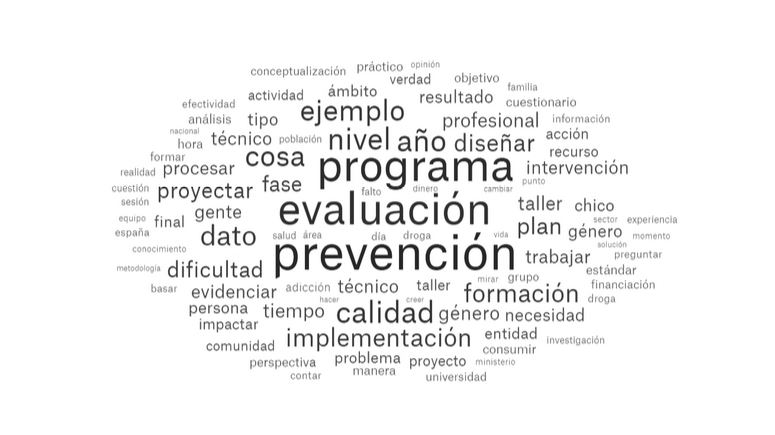
During the interviews, we identified sector concerns using tools such as word cloud analysis. The most recurrent concepts are presented below, reflecting the need for more effective interventions tailored to current demands.
Three Critical Phases of Prevention Programmes
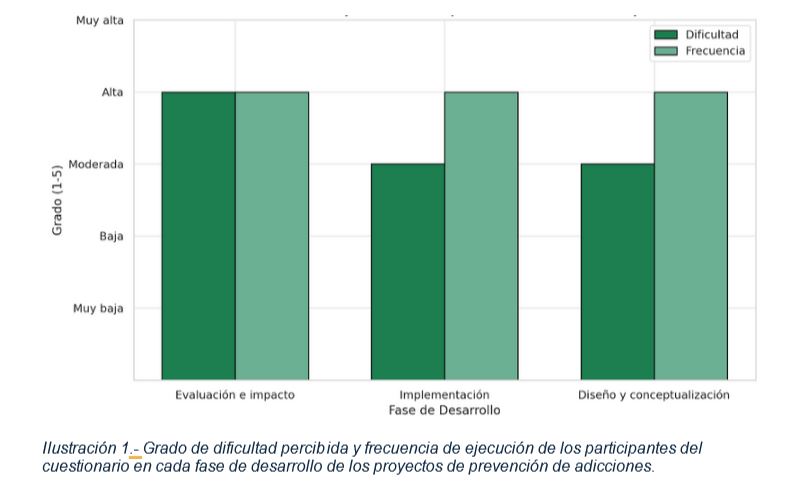
Our analysis identified three major phases in prevention programmes, with outcome and impact evaluation being the most challenging stage. Additionally, the frequency with which key tasks are performed influences perceptions of their difficulty at each phase.
1. Conceptualisation and Design
Designing an effective programme entails overcoming challenges such as ensuring sustainability and planning detailed evaluations. Tasks like defining objectives or identifying target populations are relatively accessible, but others, such as incorporating gender perspectives during the design phase, require more technical attention.
“We are repeating the same mistakes from the 1980s. We focus on the substance, not the motivation.” (0327)
2. Implementation
In this phase, securing funding, coordinating teams, and adapting to changes are frequent yet complex tasks. Monitoring with a gender perspective remains a neglected area, highlighting the need for practical training in this regard.
“I think we’re still a bit behind on this. We haven’t yet put on the glasses to look beyond the obvious and what we’ve done so far, and we struggle to detect needs with a gender perspective.” (0108)
3. Outcome and Impact Evaluation
Evaluating the effects of interventions is critical to ensuring tangible impact, yet the lack of tools and training hinders this process.
“Perhaps in a country like this, we don’t need 186 prevention programmes in schools; maybe 15 or 20 would suffice, as long as they had been shown through scientifically rigorous methods to deliver positive results.” (0320)
Strengths, Weaknesses, and Recommendations
Prevention programmes exhibit a technical commitment and progress in defining objectives. However, weaknesses persist, including a lack of training in gender perspectives and data analysis, the absence of systematic evaluation tools, and the excessive workload faced by technical teams. Strengthening collaboration among families, schools, and local organisations is also essential.
Key Recommendations
- Cross-cutting evaluation. Include it from the design stage, with gender and intersectionality indicators.
- Continuous training. Specialised programmes and professional accreditation.
- Financial sustainability. Multi-year frameworks and public-private partnerships.
- Local adaptation. International standards tailored to specific contexts.
- Applied technology. Digital tools to facilitate data analysis.
The HIGIEA project provides a foundation for designing inclusive, evidence-based policies, fostering a prevention system that prioritises quality and equity.

Leave a Reply
Want to join the discussion?Feel free to contribute!