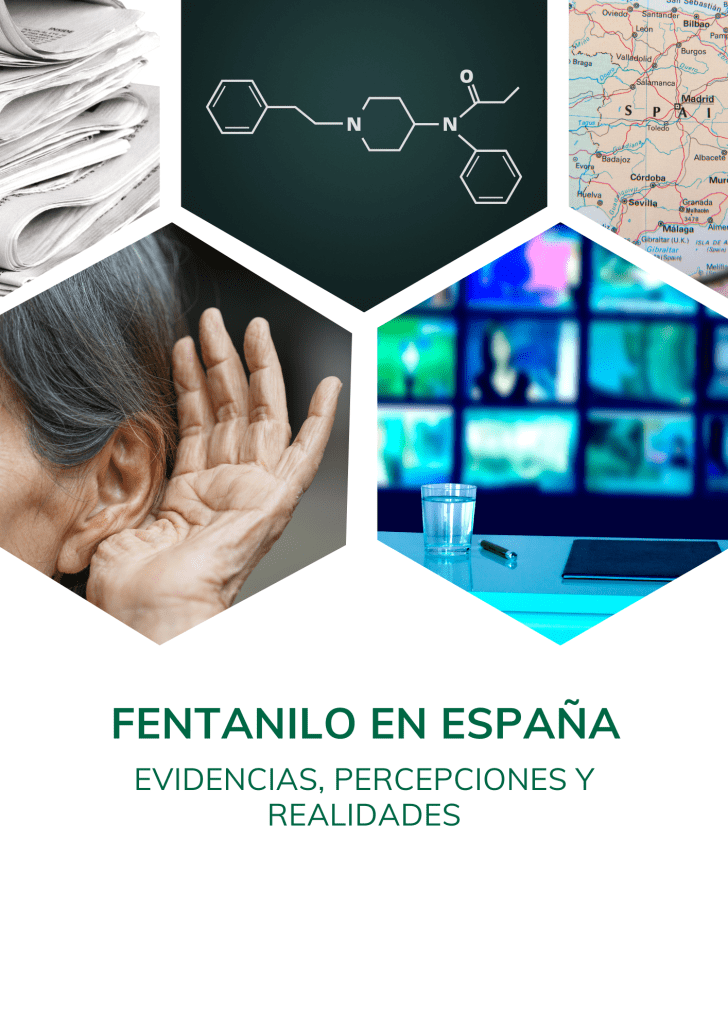
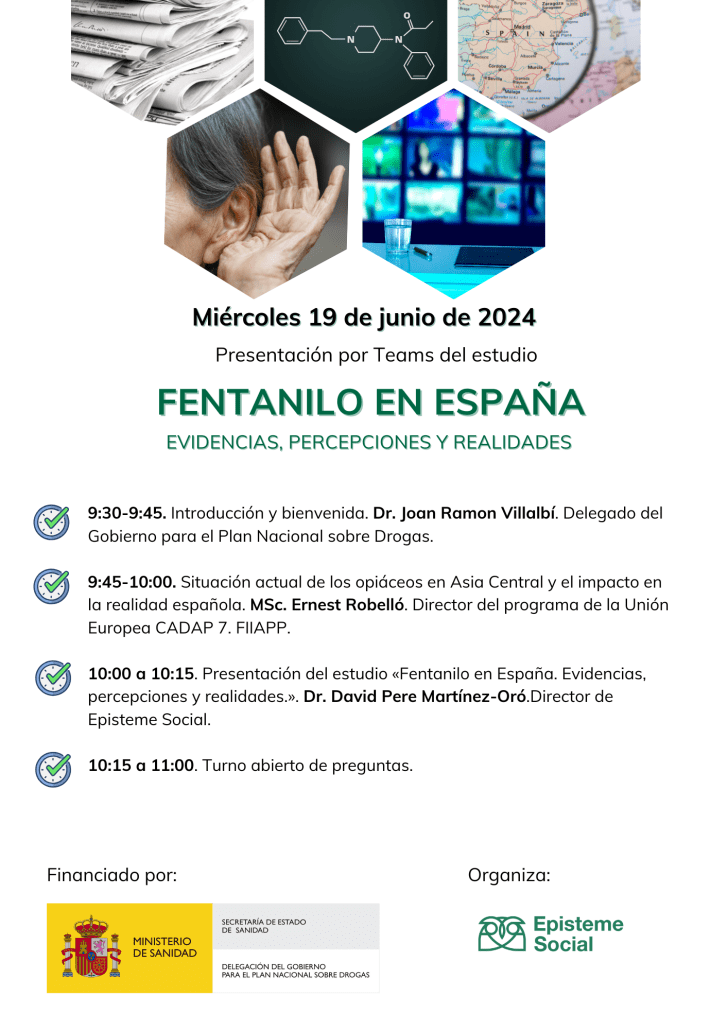
Fentanyl in Spain. Evidence, perceptions and realities
Year:
2024
Funded by:

2024
Introduction
Chapter 1. Fentanyl substitution for heroin. By way of introduction.
In the introduction we present the starting point of the study, the basic methodological aspects and the objectives. For years now, the public health crisis caused by illicit fentanyl in North America has been causing unease in Spanish society in general, and addiction professionals in particular. From September 2022 onwards and, with particular intensity, during the summer of 2023, the media published countless news stories about the arrival of fentanyl in Spain. In some cases, the medical system for prescribing opioid drugs was called into question. In the introduction, we pointed out that this is inaccurate and unfair. Spain maintains strict controls on the dispensing of opioid drugs and diversions to illegal markets are, for the moment, anecdotal. With this background, we turn to how the media storm intensified the substitution hypothesis. This hypothesis argues that fentanyls, being easier to produce and more profitable than heroin, will replace the opiate in illicit drug markets. We discuss how the hypothesis is more complex and difficult to fulfil. We end the introduction with a brief presentation of the report’s chapters.
Results
Chapter 2. Afghanistan. The cornerstone of opioid supply in Spain.
The chapter on Afghanistan is central to the study’s conclusions. The UNODC published on 5 November 2023 the report “Afghanistan opium survey 2023”.Afghanistan opium survey 2023 in which it reported a 95 % reduction in opium production in Afghanistan. Such a statement reinforced the substitution hypothesis, because if European drug markets were to run out of heroin, fentanyl would inevitably take its place. In the chapter we present the precedent of 2001, when during the first Taliban regime, the fundamentalists banned poppy cultivation. This ban had no impact on European markets, let alone Spanish ones. We continue with a section dedicated to the analysis of heroin stocks from the bumper harvests of the years 2017 to 2022. At present, heroin stocks along the transit route between Asia and Europe are considerable. We estimate that heroin stocks could supply European markets until at least October 2025 and probably up to June 2028. Moreover, if heroin shortages are severe, the first markets to be underserved would be Asian and African markets. Spain would be one of the last to run out of heroin, because it is the European country that pays the most for heroin wholesale.
In the second section we outline the processes that make it impossible for Afghanistan to continue without opium production. The factors that explain why the Taliban ban will fail are: the economic crisis, the humanitarian drama, the high price of opium, the multi-ethnic dimension, corruption, power-sharing, internal Taliban rifts and the punitive regime for disobeying the ban. Overall, the Taliban regime is unable to maintain the ban throughout the country. The famine is terrible. Evidence has already emerged from different parts of Afghanistan that cultivation has increased, albeit covertly, during the 2024 harvest. The current price of opium is very tempting for Afghan farmers in extreme poverty. At the end of February 2024, the price per kilo of opium was $1,000. In this year’s harvest, one hectare of opium will yield about 24,500 dollars, i.e. more than three times the average annual wage of a working person in Afghanistan. For the moment, Afghanistan is far from returning to the production levels of the 2022 harvest, although our hypothesis is that it will soon return to levels sufficient to supply European heroin markets.
In the third and final point, we look at the capacity of other countries to increase opium production in the light of the Afghan crisis. Afghanistan’s current weakness is the opportunity for other countries. Soaring opium and heroin prices in Eurasia represent an incentive for impoverished economies. The countries we scrutinise are five that border Afghanistan: Turkmenistan, Uzbekistan, Tajikistan, Iran and Pakistan. We also look at Burma and Mexico, plus a brief note on Laos. Of the eight countries, Pakistan and Burma are the most likely to grow opium poppy crops. Our hypothesis is that Afghanistan will not take long to regain its hegemonic position, although new players may emerge in the lucrative illegal drug markets. In any case, these dynamics will allow Europe to continue to be supplied with heroin.
Chapter 3. The supply of synthetic opioids.
The chapter on supply is divided into three sections. In the first, we present the supply of fentanyl in Europe from the first indications in the mid-1990s to the present day. We show the few reports of illicit fentanyl in Spain. The central element of this chapter is that fentanyls are on the decline and their place is being taken by nitazenes. We compile the data that demonstrate this change in trend. It is worth noting that, at the global level, fentanyl notifications to the UNODC Early Warning Advisory show a marked downward trend. In 2022, there were 56, in 2023 there were only 16. In contrast, the first notification of nitazenes was in 2019, and in 2023 they reached 14. Detections of nitazenes in Europe have been a constant since June 2023, especially in the British Isles, the Netherlands, the Baltic republics and some Eastern European countries. The emergence of nitazenes is a product of the international control process and China’s ban on fentanyls and their precursors from May 2019.
The shift of all production to illegal industries has meant that what little fentanyls and precursors China produces are used to supply US markets. The era of nitazenes could last for a long time, because their precursors are commonly used in licit economies. The drug scene, and more specifically the NPS scene, is changing and changing radically in a short period of time. As the international community intensifies the control of nitazenes, the illicit chemical industries, in search of synthetic opioids that are still legal, will put other families of synthetic opioids and even any other NPS on the market. In Spain, the space for nitazenes or any other synthetic opioid is minimal as long as its markets are supplied by Afghan heroin.
In the second section, we analyse the operations of organised heroin crime. We show how criminal gangs will find it impossible to shift their business to fentanyl or other synthetic opioids. They are more likely to show an interest in other illegal markets. Conversion of the heroin business to synthetic opioids is a pipe dream as long as they have heroin to traffic. We also look at why Mexican cartels have not introduced fentanyl into Europe as they do in North America. The reason is low demand and the complex European criminal ecosystem that makes it difficult for them to operate in opioid markets.
The third section is devoted to Estonia. The Baltic country has been living with fentanyls for thirty years. The public health problems were terrible. In 2017, the variety of fentanyls diversified. Since 2019, nitazenes have been increasingly present. Since then, xylazine has also been used as an adulterant. Data from the Baltic countries in general and Estonia in particular reinforce the hypothesis of global substitution of fentanyls by nitazenes. The Estonian case, for our purposes, serves to demonstrate that fentanyl has been circulating in Europe for decades without having had an impact on Spanish markets. Moreover, the fentanyl abuse in the Baltic country can also be explained by the absence of a solid addiction care network. Estonia shows us that Spain is prepared to deal with a hypothetical arrival of fentanyl or other synthetic opioids.
Chapter 4. The demand for fentanyl among consumers
In this chapter we discuss how heroin users might behave in the face of the arrival of synthetic opioids such as fentanyl. We also consider future scenarios and the difficulties involved in buying drugs on the dark web for the potential opioid seeker.
Central to rejecting any presence of synthetic opioids in Spanish illicit drug markets is the number of overdoses. The number of overdoses is the key indicator for claiming that Spanish streets are free of fentanyl and other synthetic opioids. Overdoses will become irrefutable evidence in case of a massive circulation of synthetic opioids. For the time being, the number of overdoses remains stable and, among those that do occur, we have no evidence that synthetic opioids are involved.
In the first section, we analysed the characteristics of demand and its relationship with opioids. Spain has around sixty thousand regular heroin users, fifty thousand of whom live in a situation of extreme marginalisation. The main profile is that of an elderly person who is a poly-drug user. The characteristic of the poly-drug user is central to understanding that, if heroin is adulterated with synthetic opioids, people may use other drugs and reject heroin use. In addition, Spain has a robust addiction care network. Having the network in place is the best guarantor against any drug threat, be it synthetic opioids or any other family of drugs. Most, if not all, people addicted to heroin are in contact with the care network, either in a treatment centre or in a harm reduction resource. A very large proportion of them participate in methadone maintenance programmes, or may use buprenorphine as a substitute. People who use drugs more intensively, in certain territorial areas, usually have naloxone available. All the resources and programmes offered by the excellent Spanish addiction care network are a strong protective factor against any eventuality or health emergency. The network is attentive to innovations in drug markets and to the emerging needs of users, especially in new or minority profiles.
In the second section we consider three scenarios of how fentanyl could reach Spain. The first. Consumers demand heroin, but traffickers sell them a substance with a higher or lower percentage of heroin, adulterated with a synthetic opioid, or they sell a substance without heroin and with synthetic opioids. This scenario is remote because heroin markets are disconnected from synthetic opioid markets. The second. Users buy stimulants (cocaine, ecstasy or methamphetamine) that, without their knowledge, are adulterated with synthetic opioids. Such a scenario is highly unlikely, because in informal markets, fentanyl is proportionally more valuable than cocaine. The third. The most likely. Consumers explicitly demand fentanyl and buy a substance whose composition is unknown, although to a greater or lesser extent it contains some synthetic opioid. Fentanyl has been widely publicised in the media. They have also claimed that illicit fentanyl is already available in Spain. Some small-scale trafficker may think it is sensible to start selling fentanyl because he believes that consumers are demanding it. The supply routes for these small-scale traffickers are threefold: dark web, drug diversion and deception. We rule out, for the moment, organised crime supplying synthetic opiates to Spanish illicit drug markets.
We conclude the fourth chapter on the marginal role that the dark web will play as a source of supply of synthetic opioids among current opioid users. This is not because the dark web lacks a supply of synthetic opioids, but because it would be materially impossible for this profile to certify a buy-sell transaction. The requirements are too demanding for this profile.
Chapter 5. Fentanyl in the eye of the media storm.
The last chapter of the results is devoted to the media storm with fentanyl at the centre. Such a media spiral started in September 2022, peaked in the summer of 2023 and, although softened, is still continuing in May 2024. The chapter is divided into two parts. First, we analyse the causes of the media storm. In the second part, we reflect on the consequences of so much fentanyl exposure.
We divided the causes of the media storm into two categories. The first was thematic, i.e. everything related to fentanyl was of interest. The second was structural, i.e. a product of the way the digital journalism business works. We found four main thematic causes. The first, and original cause, was the public health crisis caused by opioids in North America and all its derivatives. The second, the use of opioid drugs in Spain: prevalence, control systems, deviations, patients with iatrogenic addiction, etc. The third refers to news about fentanyl in a generic way, without geographical location, focusing on its effects, its analgesic potential and especially on the damage it causes. The fourth, the hypothetical arrival of fentanyl in Spain.
The structural causes of the media storm are a product of the way digital journalism works. Media outlets look for stories that “work” because they are well received by the audience. News that “works” translates into tens of thousands of views, thus producing corresponding advertising impressions, i.e. generating revenue. We analyse how fentanyl has been an attractive topic for cyber-hookers in the maelstrom of digital journalism. We present how social media trends and Google Trends monitor the topics of interest to audiences and how media professionals use these tools to feed themselves with content to write new news stories. Fentanyl was the top trend in Google Trends between 30 July and 5 August 2023, resulting in unparalleled media activity. Media outlets sought to position themselves to gain a substantive number of hits. Some professional journalists have published unfortunate news stories, at best. Most were unable to foresee the impact of the fentanyl media storm. But, if only as an unintended consequence, the multitude of stories published on such a sensitive and shocking issue has altered social reality.
In the second part we present an analysis of the consequences of media impact. We identify five consequences of the information storm. The first is very tangible. It refers to all the training and preventive strategies put in place. Although there is no illicit fentanyl in Spain, the fear provoked by the hypothetical arrival of illicit fentanyl has catalysed somewhat exaggerated responses. Second, the media spiral has required professional attention, and not only in attending to the media, but so much news about fentanyl has occupied the frame of thought of different professionals, because the North American background required it. But the attention was unjustified if we look at the indicators and the social reality. So much attention has led to the neglect of other relevant issues, for example, methamphetamine use. The third, making the whole Spanish population aware of the more sordid side of illicit fentanyl, has led to confusion with the drug. The advertising of fentanyl has led to uncertain consequences for patients and for society in general. Fourth, difficult to assess, but it is questionable to what extent medical professionals are now more resistant to prescribing opioid drugs or more insistent on withdrawing dosing regimens that might be justified. Fifth, and most important, are the seizures of fentanyl drugs diverted from licit channels. The media firestorm has made some people want to take this much-talked-about potent drug. Drug dealers have not hesitated to source fentanyl from pharmaceutical diversions. The media storm has made the prophecy self-fulfilling, because it has stimulated demand among people who would never have known about the potent opioid without the news.
Chapter 6. The persistence of heroin. By way of conclusion.
The conclusion of the study ‘Fentanyl in Spain: evidence, perceptions and realities’ is that Spain will not suffer a public health crisis from synthetic opioids, nor will the hypothesis of heroin substitution by fentanyl be fulfilled. There are four reasons for this. The first reason is that heroin produced from Afghan opium will continue to supply European markets because organised crime has stocks and Afghanistan has returned to opium cultivation for the 2023-2024 season. The second reason is that fentanyls are in sharp decline on world markets. Nitazenes, most of which are still legal and require precursors that are commonly used in licit economies, now dominate. In Spain, in the hypothetical case of a clandestinely produced synthetic opioid appearing, it is more likely to be a nitazene than a fentanyl. The third reason is the low demand for opioids. Fentanyl has been talked about too much without posing a real threat. Methamphetamine is more likely to be an addiction trend-setter in the coming years. The fourth reason is that, should synthetic opioids become a reality, Spain’s powerful addiction care network could provide effective, efficient, effective, efficient and quality responses to the demands of these new substances.
Chapter 7. Recommendations. Serenity and professionalism.
We conclude the report with some brief recommendations regarding the aspects to be assessed in the event of a hypothetical reception of synthetic opioids. The recommendations are divided into the following areas: training and awareness-raising, care network, harm reduction resources, monitoring and surveillance, research and dissemination. The importance of the availability of naloxone in the event of an increase in the use of fentanyl or other synthetic opioids should be emphasised.
The conclusion of the study ‘Fentanyl in Spain. Evidence, perceptions and realities’ is that Spain will not experience a public health crisis caused by fentanyl or other synthetic opioids. Nor will the hypothesis of heroin substitution by fentanyl be fulfilled. The reasons for the conclusion are fourfold.
Reason one. Heroin produced from Afghan opium will continue to supply European drug markets. Heroin stocks, the product of exceptional harvests prior to 2023, will allow Europe to be supplied until at least October 2025. Beyond stocks, Afghanistan cannot survive without opium revenues. Despite the Taliban ban, the terrible economic crisis, the humanitarian situation, famine, the high price of opium, corruption, the disintegration of power and, above all, the Taliban’s internal disagreements make the ban untenable. Opium production, as long as the Taliban regime remains in place, will never return to its former volume, but it will be sufficient to supply Europe. In the event of a shortage, the first markets to be cut off would be those where the wholesale price of heroin is lower, i.e. Asia and Africa. Spain would be one of the last countries, if not the last, to run out of heroin, because it is the European country that pays the highest wholesale price for heroin. In addition, other Asian countries, such as Pakistan and Burma, have increased opium poppy cultivation. Still, far from Afghanistan’s historic figures, but enough to help meet the demand for heroin.
Second reason. Fentanyl and its illicitly produced analogues have been and will continue to be absent, beyond anecdote, from Spanish markets. Globally, fentanyls are in sharp decline, due to both the international control process and China’s ban in 2019. Illegal companies in China, India and Pakistan continue to manufacture fentanyl precursors but, in global terms, availability is significantly lower than before 2019. Scarce production is sold to Mexican cartels. These cartels are willing to pay a higher price because they want to maintain the business of meeting the high demand in North America. Legal Chinese companies, once fentanyl and its precursors were brought under control, started to look for alternatives in line with Chinese legality. From 2019, nitazenes appeared as a legal alternative to fentanyl. Since then, reports of fentanyl have trended downwards and those of nitazenes upwards. The fentanyl era has come to an end. Nitazenes, year after year since 2019, have increased their presence in the American and European markets. In Spain, in the hypothetical case of a clandestinely produced synthetic opioid appearing, it is more likely to be a nitazene than a fentanyl. Xylazine could also appear as an adulterant, as it has done in other countries in recent months, especially in the UK. However, this is rather unlikely, because synthetic opioids have been circulating in Europe for more than thirty years and have always been absent in Spain. In any case, as long as Afghan heroin is available, these would be one-off situations that could inflict severe harm and even fatal overdoses, but in no case would they strictly speaking lead to a public health crisis . The nitazenes control process initiated in 2021 has stimulated NPS researchers to continue their perennial research on legal psychoactive substances. This research may lead to the emergence of other families of synthetic opioids or to the emergence of different NPS. This cannot be ruled out.
Third reason. The volume and nature of demand for opioids makes a public health crisis unfeasible. Spain has a mere sixty thousand regular heroin users. Most of them are elderly people with long experience of drug use and survivors of all kinds of calamities. The dominant profile is that of a poly-drug user with a high resilience. In the event of the emergence of synthetic opioids, users may replace heroin with other substances, ranging from benzodiazepines to methamphetamine. In our opinion, methamphetamine is currently the emerging substance that poses the greatest danger to public health. Fentanyl has been talked about too much without posing a real threat. Methamphetamine, because of its evolution in recent years, is the substance that deserves the most attention.
The fourth and last, but most important reason. Should fentanyls become a reality, Spain’s powerful addiction care network could offer effective, efficient, effective, efficient and quality responses to the threat. Opioid substitution treatments with methadone and buprenorphine, the availability of naloxone in different presentations, highly qualified professionals and a network of resources distributed territorially are the best guarantee against any threat from synthetic opioids or any other substance. The number of overdoses is the key indicator that Spain is free of fentanyl and other synthetic opioids. Overdoses will become irrefutable evidence when users consume synthetic opioids. For the time being, the number of overdoses remains stable.
Having said this, and to conclude the report, we would like to highlight two aspects. The first is a note on how the substitution hypothesis has worked in the patterns of thinking about the phenomenon. The second is a reflection on the uncertain scenario caused by fentanyl drug diversions.
The frames of reference in abstract thinking help us to understand the fentanyl phenomenon in Spain. From the expert point of view, we conceptualise all substances between opium and carfentanil in a logical and coherent continuum, because they all belong to the opioids, i.e. we order opioids by their effects and analgesic potency. Therefore, we think that if there is a shortage of one opioid, another opioid will replace it, i.e. if we run out of heroin, fentanyl will follow. This is not necessarily the case. Heroin criminal organisations understand the opiate as a completely separate substance from synthetic opioids. Organised crime conceptualises opioids on the basis of criminal logic, i.e. how to supply, what difficulties are involved in trafficking and how much profit it will yield. Criminal gangs historically dedicated to heroin might not even consider trafficking synthetic opioids; that is, if they find it unviable to operate with heroin, they might consider methamphetamine, cobalt or bitcoins to continue their criminal activity, but not necessarily fentanyl or another synthetic opioid. The substitution hypothesis has worked in Spain by analogy with North America, although the realities are incomparable.
And, more than a conclusion, a final reflection. The media storm over fentanyl in the last two years has had social consequences that we have not yet been able to glimpse. Despite the excellent control mechanisms, the seizures of fentanyl drugs in the possession of micro-traffickers are worrying, albeit so far only on an ad hoc basis. We wonder to what extent the supply of fentanyl diverted for misuse is stimulated by a demand created by so many news stories about fentanyl as a self-fulfilling prophecy. We shall see.

 ATENEA: External evaluations of active addiction prevention programmes.